More on Figure–Ground (and What I’m Learning)
Continuing from my earlier blog post focusing on quilt design, Color Theory and Quilt Background Color Selection, I’d like to share progress on the quilt I featured that I’m now calling “Jelly Bellies” and some thoughts on my decision-making process.
As a reminder, figure–ground relationship refers to the relationship between a form and its background. It can also be described as the contrast between positive space (the figure) and negative space (the background). I learned this term from a couple of Nancy Crow talks on YouTube. While I haven’t had the opportunity to study with her directly, I gathered from these talks that shape, color, line, and texture are all elements that can be manipulated by the quilt maker to create contrast between figure and ground.
After considering the gray I wanted for my background, I purchased two cuts of fabric: one mid-value with a brownish cast and another in a rich, dark charcoal. Once home, I auditioned the fabrics and decided to go with the mid-value gray. I was pleased with the contrast between the multicolored shapes (the figure) and the background.
After piecing several units and using up the two yards of gray, I began to wonder what would happen if I introduced the charcoal into the background. I liked the effect of the added variation, especially while keeping the proportion of charcoal smaller. Then I had another “what if” moment and added a light-value gray from my stash—again, keeping the original mid-tone as the primary ground.
I like how the varied background values and densities create a subtle visual shift, reversing some of the figure–ground relationships. The varied values in the ground add depth, creating areas of added movement within the composition. This added complexity is something the design would have lacked had I used a single, solid gray background.
Here are some progress shots.
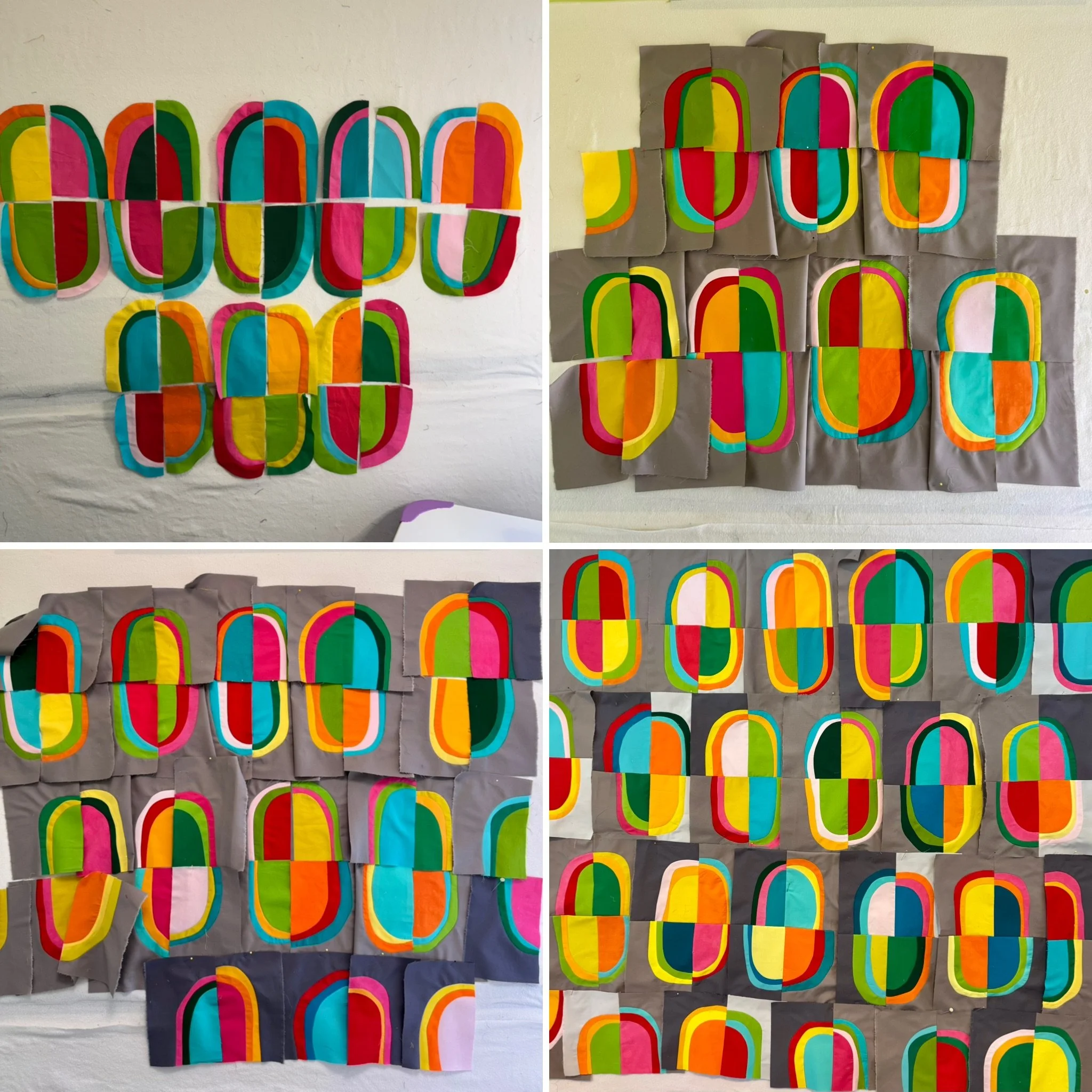
Progress on “Jelly Bellies”
The next step is to sew all the “Jellies” together (each Jelly consists of four units already sewn together). It will take some time to determine the right spacing between them—again, coming back to the figure–ground relationship and its role in the overall composition.